
Nelson Medical • Psychology
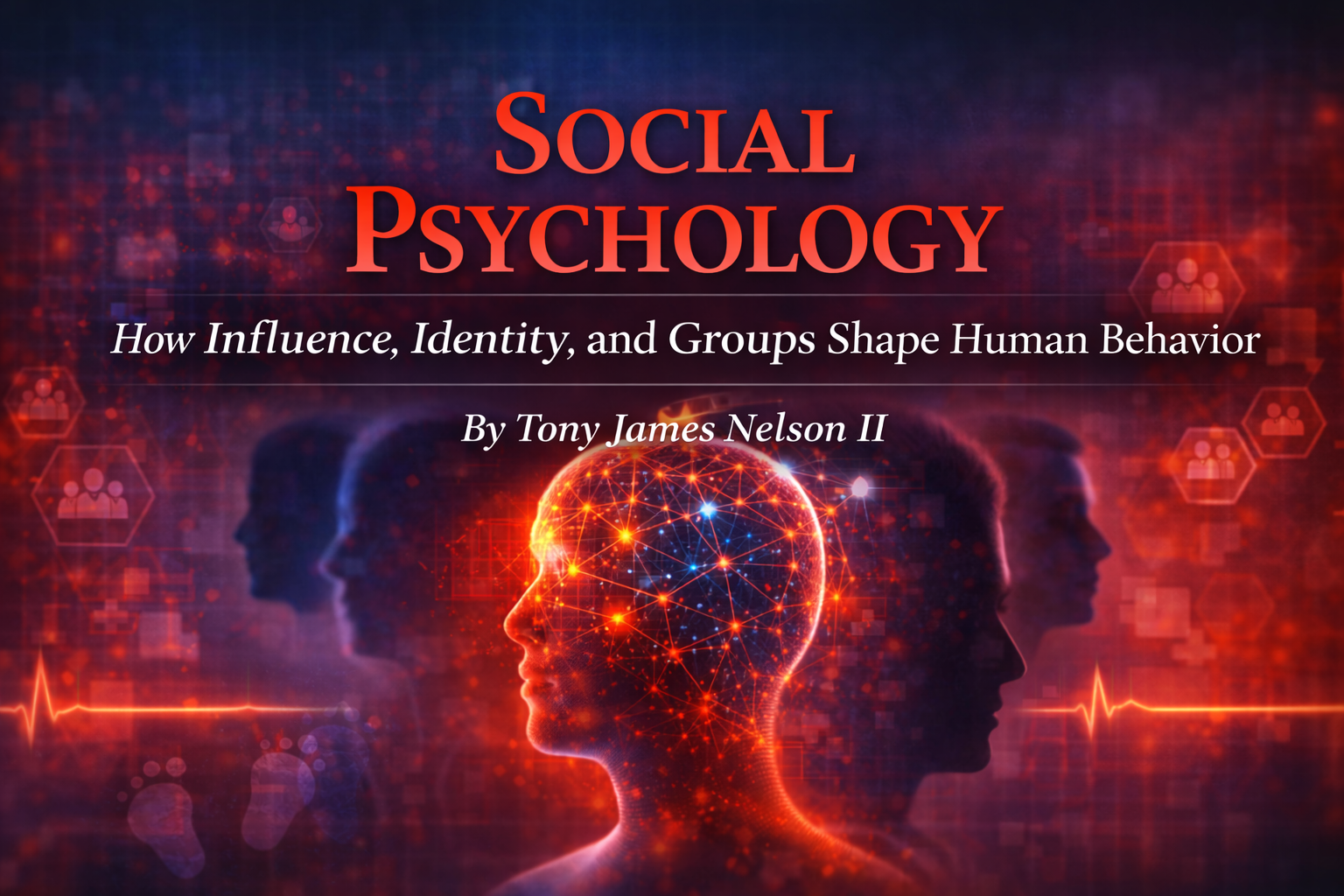
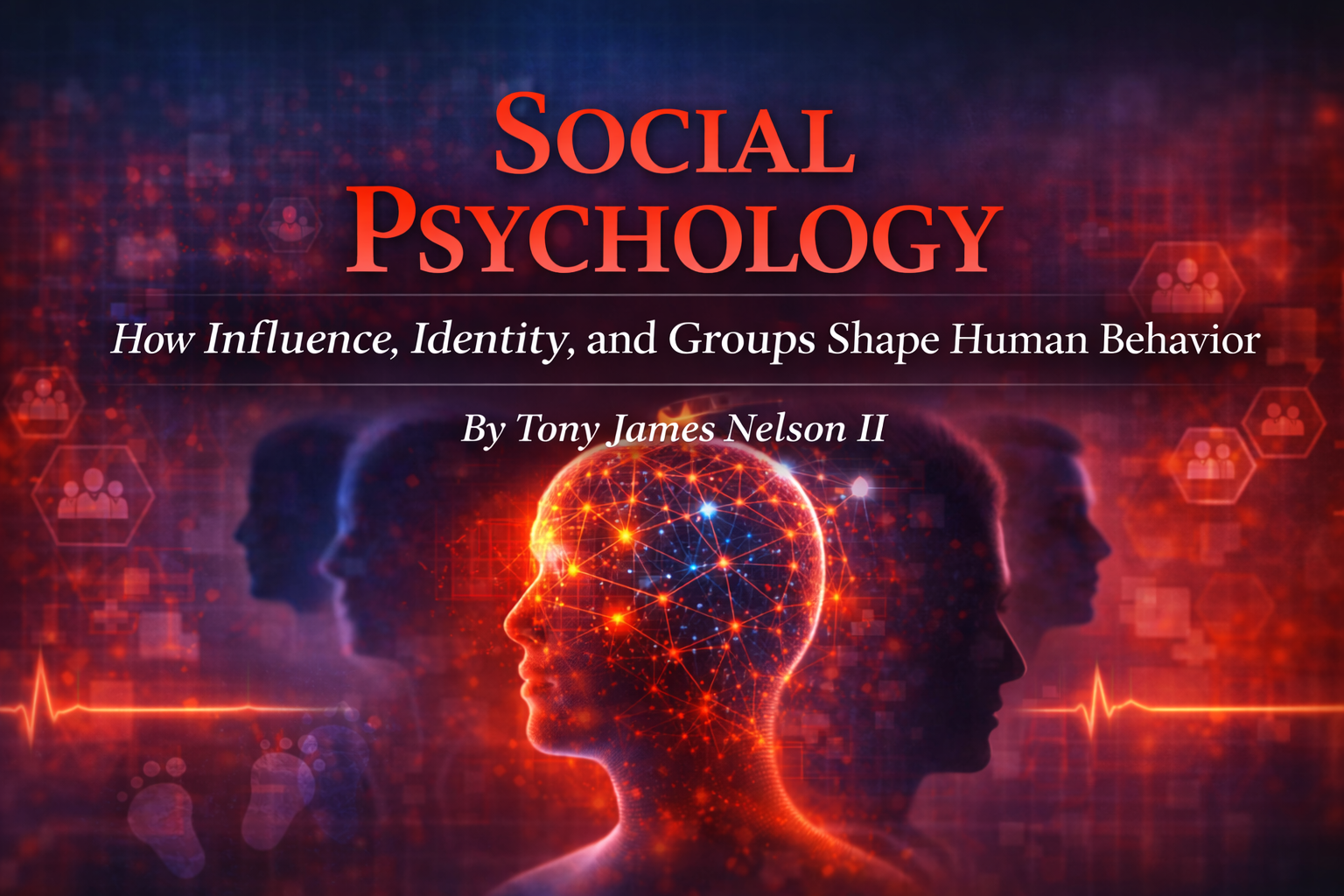
Understanding Social Psychology: How Influence, Identity, and Groups Shape Human Behavior
Social psychology is the science of how people think, feel, and behave in social contexts. It explains why good people follow bad rules, why crowds can become brave or cruel, why first impressions feel “obvious,” and why our beliefs often shift when we’re surrounded by confident others. This article provides a high-resolution, clinical-grade overview of the major mechanisms—social influence, norms, identity, attribution, bias, and group dynamics—while translating them into practical tools for clearer thinking and healthier relationships.
1) What Social Psychology Is
Social psychology studies how the presence of other people—real, imagined, or implied—shapes thought and behavior. That influence can be obvious (peer pressure) or invisible (norms, assumptions, cultural scripts). In daily life, social psychology is the difference between “who you are” and “who you become when the room changes.”
High-yield concept: Most people are not “irrational.” They are socially optimized—built to belong, coordinate, and survive in groups.
The social triad
- Self: identity, goals, values, emotions
- Others: influence, expectations, feedback
- Situation: norms, power, scarcity, danger, ambiguity
Behavior is often less about “personality” than about the interaction between the person and the situation.
2) How We Know: Experiments, Ethics, and Real-World Validity
Social psychology relies heavily on experiments because social effects can be subtle, fast, and confounded by background variables. Controlled designs allow researchers to isolate mechanisms (e.g., conformity under uncertainty, obedience under authority, or bias under time pressure).
Modern social psychology also uses field studies, longitudinal methods, and computational models (especially when studying networks, crowd behavior, and digital environments). Ethical standards are stricter than in past decades—today’s goal is insight without harm.
3) The Social Self: Identity, Roles, and Self-Presentation
The “self” is partly internal and partly social. We learn who we are through feedback, comparison, and role expectations. In practice, identity is a set of commitments: groups we belong to, values we defend, and narratives we live inside.
3.1 Social identity
Social identity is the part of self-concept derived from group memberships (“us” vs. “them”). This can produce solidarity and meaning—but it can also generate bias when group status feels threatened.
3.2 Self-presentation
People manage impressions constantly: what we reveal, what we hide, and what we signal. This isn’t always deception; often it’s coordination. Social life runs on readable signals.
4) Social Perception: First Impressions and Mental Shortcuts
Humans make rapid judgments under incomplete information. This is efficient, but it introduces predictable distortions: we overvalue confidence, confuse familiarity with truth, and interpret ambiguous behavior through prior beliefs.
Common shortcuts
- Halo effect: one positive trait spills into global judgment
- Availability: vivid examples feel common
- Representativeness: “looks like” becomes “is”
- Naïve realism: “I see it objectively; others are biased”
5) Attribution: Explaining Behavior (Often Incorrectly)
Attribution is how we explain why someone did something. Under uncertainty, humans default to story-making: we infer character traits from single actions, even when the situation is doing most of the work.
High-yield concept: We tend to explain others by personality and ourselves by context.
This imbalance is one reason conflicts escalate. If you interpret a partner’s missed text as disrespect rather than stress, you will respond to a different reality.
6) Attitudes, Beliefs, and Cognitive Dissonance
Attitudes are evaluations (good/bad) attached to people, ideas, or behaviors. They guide attention and decision-making—but they can also be shaped by behavior itself.
6.1 Cognitive dissonance
Cognitive dissonance is the discomfort created by inconsistency (beliefs vs. actions). Humans reduce dissonance by: changing beliefs, changing behavior, or changing interpretation.
7) Influence: Conformity, Compliance, Obedience
Influence is not always manipulation. In functional groups, influence is how people coordinate and prevent chaos. The problem arises when the group’s “coordination” drifts away from ethics, evidence, or human dignity.
7.1 Conformity
Conformity increases when the task is ambiguous, the group is unanimous, status differences exist, and the social cost of dissent is high. People often conform to avoid exclusion, not because they are convinced.
7.2 Compliance
Compliance refers to saying “yes” to a request. It increases with reciprocity, consistency, liking, authority cues, and scarcity signals. These are not mystical; they are predictable features of social learning.
7.3 Obedience
Obedience becomes dangerous when authority is unchallengeable, accountability is diffused, and the system rewards silence. The antidote is structured dissent: norms that make questioning safe and expected.
8) Groups: Norms, Polarization, Groupthink, Deindividuation
Groups shape behavior through norms (what is typical) and moral narratives (what is “right”). Under stress, groups may polarize and simplify.
Group dynamics to know
- Group polarization: discussion drives opinions to become more extreme
- Groupthink: cohesion suppresses critical evaluation
- Deindividuation: anonymity reduces self-monitoring and increases impulsive action
High-yield concept: When identity becomes fused with the group, evidence can feel like betrayal.
9) Bystander Effect and Prosocial Behavior
The bystander effect occurs when help is less likely in groups, partly due to diffusion of responsibility and uncertainty about what’s happening. Prosocial behavior increases when the situation is clear, responsibility is personalized, and helping is normed and modeled.
10) Prejudice, Stereotypes, and Implicit Bias
Bias is not only a personal failing; it is also a cognitive compression system. Stereotypes can form from repeated exposure, cultural narratives, and selective attention. They become prejudice when paired with evaluation and discrimination.
Implicit bias refers to automatic associations that can influence perception and micro-decisions even when explicit beliefs are egalitarian. The goal is not self-flagellation; the goal is accurate self-knowledge and systems that reduce bias impact.
Reducing bias impact (high-level)
- Slow down high-stakes decisions
- Use structured criteria and checklists
- Increase meaningful contact across groups
- Audit outcomes, not intentions
11) Attraction, Love, and Social Bonding
Attraction is influenced by proximity, familiarity, perceived similarity, reciprocal liking, and emotional safety. Long-term bonding is more than chemistry—it is the repeated experience of being understood and respected under pressure.
12) Aggression and Violence in Social Context
Aggression is shaped by learning, stress physiology, frustration, perceived threat, and social modeling. Environments that normalize humiliation, dominance, or retaliation increase the probability of aggressive scripts. Prevention often requires addressing context: safety, resources, sleep, substance use, and conflict norms.
13) Media, Misinformation, and Network Effects
In networked environments, social proof scales. Repetition increases perceived truth, and emotionally arousing content travels faster. Algorithms amplify what retains attention, not what is most accurate—so social psychology is now inseparable from digital literacy.
High-yield concept: When identity is at stake, “facts” compete with belonging.
14) Clinical & Practical Applications
Social psychology is clinically relevant because social environments regulate physiology: threat increases arousal, belonging reduces stress, and chronic conflict can sustain hypervigilance. Practical applications include:
- Communication: reduce attribution errors, increase curiosity, clarify needs
- Teams: build norms for dissent, accountability, and psychological safety
- Health behavior: leverage social proof and identity-based habits
- Clinical work: address shame, social threat, and interpersonal avoidance
FAQ
Is social psychology “common sense”?
Many findings feel obvious after the fact, but they are frequently counterintuitive in real time. Social psychology earns its value by measuring effects, identifying boundaries, and showing when intuition fails.
What is the single biggest driver of behavior: personality or situation?
Both matter. The most accurate answer is interaction: who you are changes what a situation does to you, and situations can reveal parts of you you didn’t know existed.
How do I protect myself from manipulation?
Watch for urgency, isolation, shame, and authority that cannot be questioned. Ask: “What would change your mind?” Healthy systems can answer.

Leave a comment